Seongmin Kim
Postdoctoral Researcher, Department of Chemistry, University of Toronto

I develop AI models to discover new materials and new chemistry. I am a postdoctoral researcher in The Matter Lab at the University of Toronto with Prof. Alán Aspuru-Guzik and Prof. Varinia Bernales.
I received my Ph.D. in Chemical and Biomolecular Engineering from KAIST, working on AI for material synthesis with Prof. Yousung Jung, and continued as a postdoc in his group at Seoul National University. Before that, I studied lithium-ion battery materials for my M.S. at Seoul National University with Prof. Kyu Tae Lee, and received my B.S. in Chemical Engineering from POSTECH.
Synthesizable materials design
Machine learning and large language models that predict whether an inorganic material can be made, redesign candidates to be synthesizable, and plan their synthesis recipes.
Agentic AI for materials chemistry
Multi-agent systems that reason, debate, and act across the steps of materials chemistry, from design to synthesis.
Self-driving labs
Self-driving laboratories that close the loop between AI and experiment to accelerate materials discovery.
The papers behind each direction are on the publications page.
Featured project
Materealize: an end-to-end workflow from materials design to materials realization
Materealize takes a target property as a prompt and carries it all the way to a synthesis report. It generates candidate structures, checks their properties and novelty, predicts which ones can actually be made, and proposes how to make them.
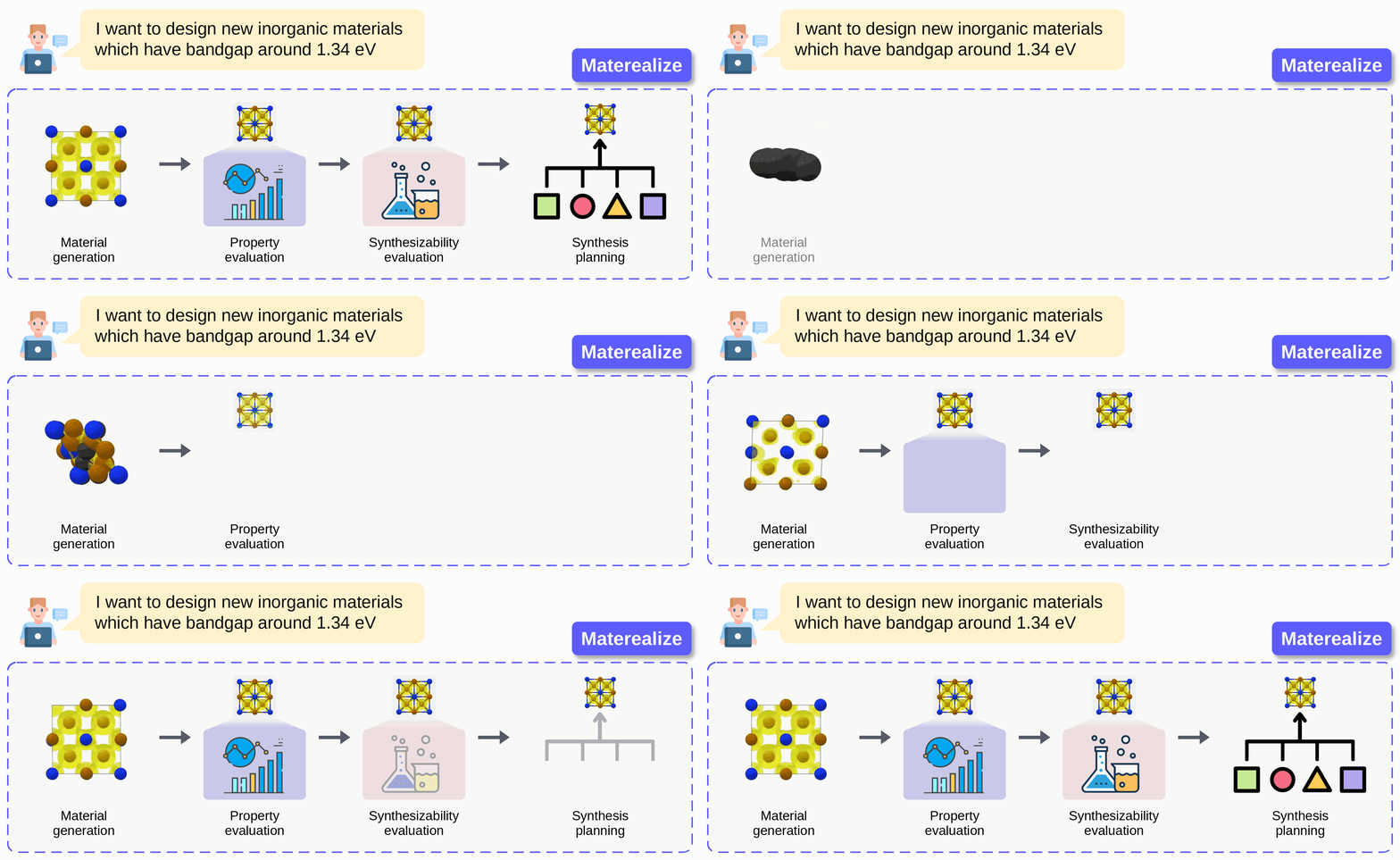
Instant mode ~2 min
Conditional generation, synthesizability prediction, and synthesis planning in one pass: precursors, heating temperature, an explanation of the prediction, and a redesigned structure when a candidate is not synthesizable.
Thinking mode ~30 min
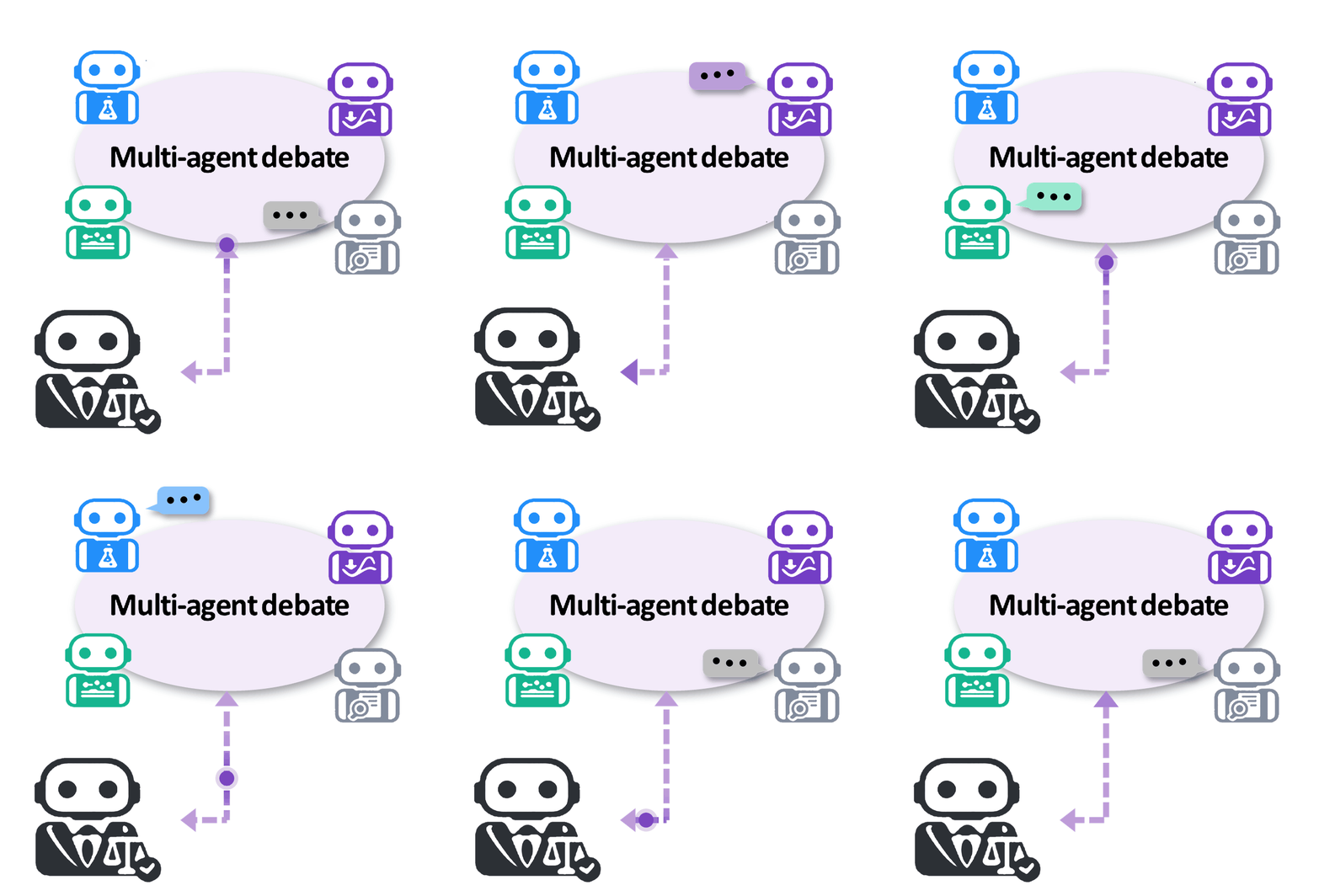
A selected candidate goes to a multi-agent debate. Specialist agents argue over the synthesis route with their own ML tools, and a judge agent writes the final synthesis report.
Multi-agent debate
Instead of one model giving one answer, four agents each look at the candidate from a different angle and challenge one another:
- Precursor agent on which starting materials to use
- Thermodynamic agent on whether the target is stable to form
- Surface & kinetics agent on how the reaction proceeds
- Literature agent on what has been reported before
A judge agent weighs the debate and returns a synthesis report with the proposed route and the reasoning behind it.
news
| Jun 2026 | Gave an invited talk at the Canada-Korea Conference (CKC 2026), AKCSE. |
|---|---|
| Mar 2026 | Joined the University of Toronto as a postdoctoral researcher with Prof. Alán Aspuru-Guzik and Prof. Varinia Bernales. |
| Feb 2026 | Gave an invited talk at the Department of Energy Engineering, KENTECH. |
| Nov 2025 | Visited the University of Toronto as a visiting scholar, hosted by Prof. Alán Aspuru-Guzik. |
| Oct 2025 | Gave an invited talk at the Department of Chemistry, Seoul National University. |